
If you are planning a renovation in New York City, whether it is a kitchen upgrade in the Bronx or a full commercial buildout in Brooklyn, you may hear one question early in the process: what is a demolition contractor, and why do you need one?
In a city like New York, where buildings are older, tightly packed, and heavily regulated, demolition is a precise, safety-focused, and highly regulated phase of any remodeling project. Understanding this role helps homeowners and business owners make better decisions, avoid costly mistakes, and start their renovation on solid ground.
A demolition contractor is a licensed professional responsible for safely removing parts of a structure or an entire building to prepare the space for renovation or new construction.
In residential remodeling, demolition usually means selective removal. This can include tearing out old kitchens, bathrooms, flooring, walls, ceilings, decks, or basements while keeping the rest of the structure intact.
In commercial projects, demolition may involve removing partitions, ceilings, storefront interiors, or outdated systems to allow for a modern layout.
The key word here is controlled. A professional demolition contractor knows how to remove what is no longer needed without damaging what must stay.
Many homeowners assume demolition is simple. In reality, professional demolition is closer to surgery than destruction.
Here is a simple comparison:
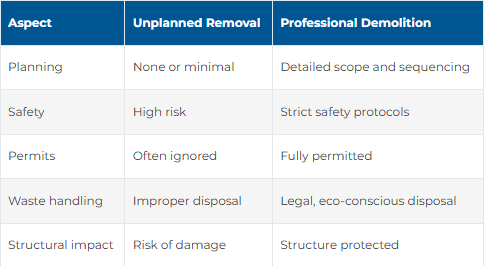
In NYC, improper demolition can lead to stop work orders, fines, or damage to neighboring properties. This is one reason licensed contractors are essential.
New York City is unlike most places in the US when it comes to construction.
More than 80 percent of New York City’s housing units were built more than 50 years ago, meaning many structures are older and may reveal unexpected issues during renovation and demolition work (source).
Older buildings often include:
A demolition contractor understands these challenges and plans accordingly.
Not all demolition jobs are the same. In home improvement and remodeling, demolition is usually selective and interior-focused.
Common Residential Demolition Services
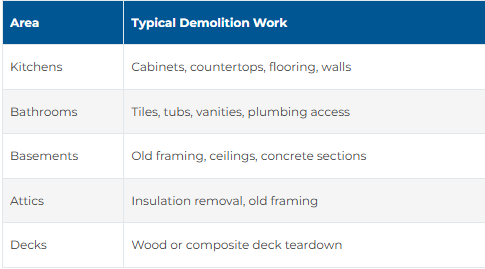
Commercial Demolition Examples
According to the market data, interior renovation and remodeling projects now account for nearly 50 percent of total construction spending (source).
This shows how demolition is increasingly tied to remodeling rather than full teardown projects.
One of the most important answers to the question “What is a demolition contractor?” is this: they are responsible for safety and compliance.
In NYC, demolition work often requires:
According to the market data, interior renovation and remodeling projects now account for nearly 50 percent of total construction spending (source).
This shows how demolition is increasingly tied to remodeling rather than full teardown projects.
One of the most important answers to the question “What is a demolition contractor?” is this: they are responsible for safety and compliance.
In NYC, demolition work often requires:
The construction industry accounts for nearly 48 percent of workplace fatalities in the US, with demolition being one of the higher-risk activities (source).
A licensed demolition contractor reduces this risk through training, equipment, and planning.
Demolition today is not just about removal. It is also about responsible waste management.
The Environmental Protection Agency reports that construction and demolition debris accounts for over 600 million tons of waste annually in the US (source).
In NYC, materials must be separated and disposed of properly. Many demolition contractors recycle:
This not only protects the environment but can also reduce disposal costs for homeowners.
You may need a demolition contractor if your project includes:
If permits are required, demolition should always be handled by licensed professionals.
Demolition is usually the first physical step in a renovation, but it should never be the first decision.
A professional general contractor often coordinates demolition as part of a larger plan that includes design, permits, construction, and finishing.
Here is a typical workflow:
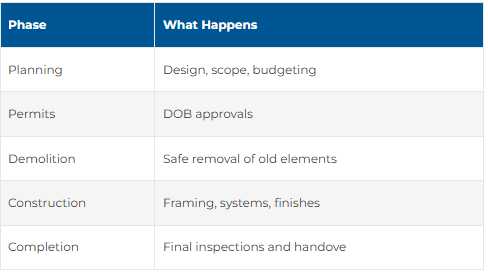
This integrated approach avoids delays and surprises.
Demolition costs vary depending on size, materials, access, and permits.
Factors that affect cost include:
Choosing the lowest price without proper licensing can lead to higher costs later.=
Once demolition is complete, the real transformation begins. This is where coordination matters most.
Working with a contractor who handles both demolition and renovation ensures:
For homeowners and business owners in NYC, this approach is often more efficient and less stressful.
Now that you understand what a demolition contractor is, the next step is choosing one that fits your project and location.
In New York City, look for a contractor who is
This is especially important for kitchens, bathrooms, basements, and full interior renovations where demolition and rebuilding go hand in hand.
Elkanah Remodeling Co. supports homeowners and businesses across New York City by handling demolition and remodeling the right way from start to finish. As a licensed, bonded, and insured general contractor, the team understands NYC building codes, permit requirements, and safety standards, which are especially important for older residential and commercial properties.
From kitchen and bathroom remodels to basement, attic, deck, and commercial buildouts, demolition is coordinated seamlessly with construction to keep projects on schedule.
Small cosmetic removal may be allowed, but most demolition tied to remodeling requires permits and licensed contractors to meet NYC safety and building codes.
For apartments or homes, interior demolition usually takes a few days to a week, depending on size, access, and required inspections.
Yes, which is why noise control, dust containment, and coordination with building management are essential in NYC multi-unit properties.
Understanding what a demolition contractor is helps homeowners see why the early stages of a renovation matter just as much as the final look. Safe, planned demolition protects the structure, keeps projects compliant with NYC codes, and sets the stage for quality remodeling.
For homeowners and business owners in New York City, working with a licensed and experienced contractor makes the process smoother and less stressful. Elkanah Remodeling Co. brings demolition and full renovation services together under one trusted team.
If a remodel is on the horizon, reaching out for a professional consultation is a smart first step.